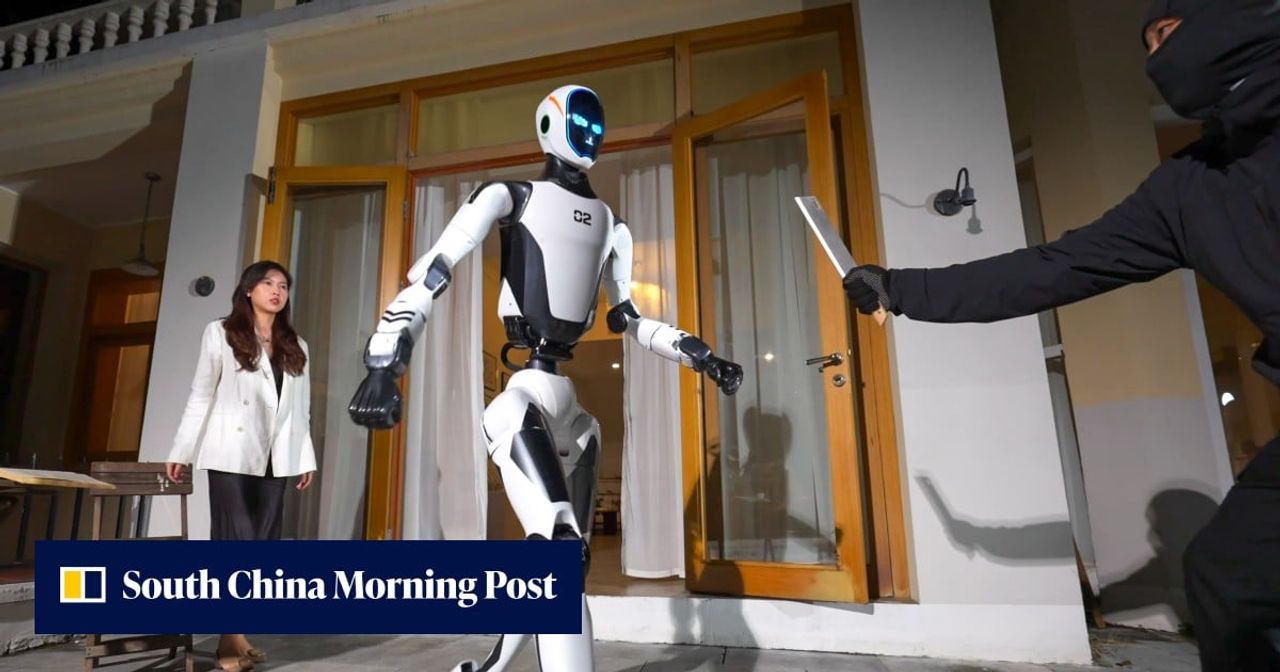
Unitree Robotics has released promotional footage for its H2-X humanoid showing it disarming a knife-wielding intruder, lifting a car off a trapped victim, and pulling a pedestrian from traffic. The staged scenes matter less than the strategic signal: China's leading humanoid maker is actively hunting for applications that justify the hardware.
This is the central tension in the entire humanoid sector right now. The engineering of bipedal locomotion and dynamic balance has outrun the business case. Unitree, Tesla, Figure, and Boston Dynamics can all make a robot walk, run, and recover from a shove, but none has a defensible answer to the question of what a customer pays for. By leaning into a 'guardian' narrative, Unitree is testing an emotionally resonant category, personal and public safety, rather than the usual logistics-and-warehouse pitch. The risk is obvious. A machine marketed to physically confront humans invites liability, regulatory scrutiny, and failure modes that a pick-and-place arm never faces. Promotional capability and field-deployable capability are different things, and the gap is where most robotics startups die.
The deeper global story is cost structure. Unitree has consistently undercut Western rivals on price, and if it can pair aggressive pricing with a credible use case, it reshapes the competitive math for everyone building embodied AI. Hardware margins compress, software and the autonomy stack become the real battleground, and the supply chain tilts further toward Chinese actuators, reducers, and sensors.
For Japan, this is a direct strike at a domain the country has treated as home turf. Japanese firms have led industrial robotics for decades and bet heavily on service and care robots for an aging society, yet they have been slow and cautious on general-purpose humanoids. A low-cost Chinese platform aimed at eldercare-adjacent and safety applications pressures exactly the market Japan assumed it would own. For Japanese SIers and automation teams, the lesson is that the next wave of 'RPA' moves off the screen and into the physical world. The skills that matter shift from scripting software workflows to integrating perception, safety certification, and liability frameworks around autonomous machines. Integrators who treat humanoids as a 2030 problem risk ceding the systems-integration layer, the part where Japanese firms are genuinely strong, to whoever controls the cheapest capable platform. The practical move now is to build pilot competence and safety governance early, before the hardware economics force the decision.




