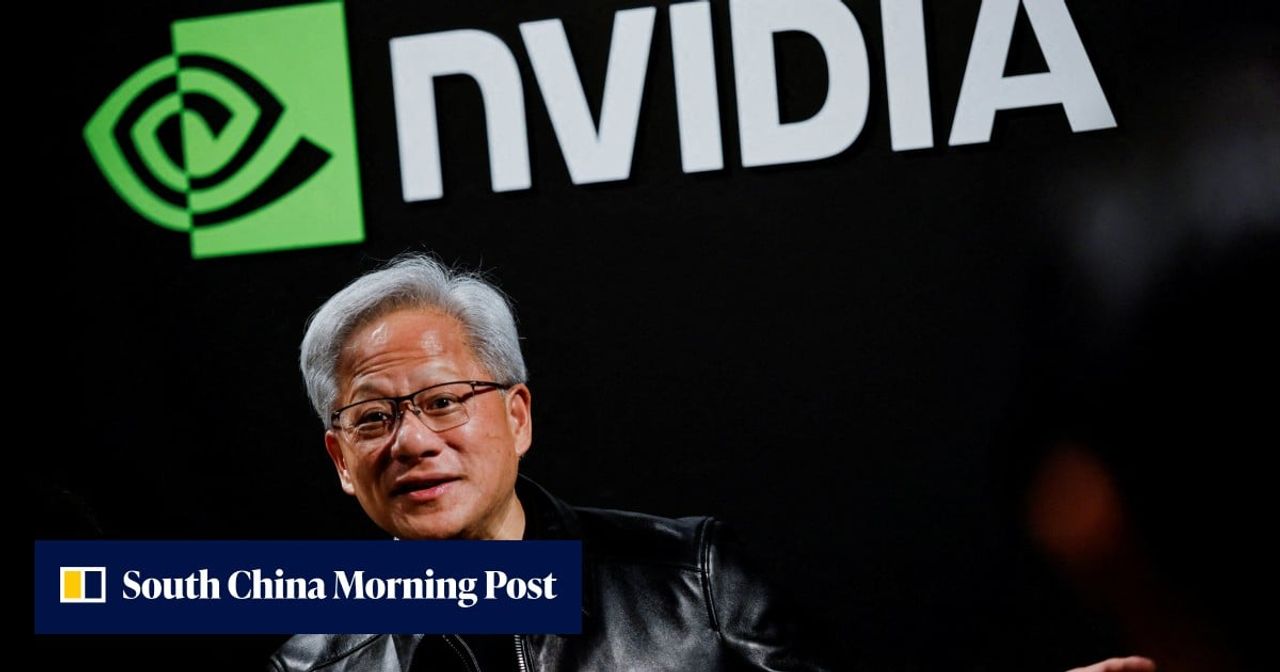
Jensen Huang's appearance in Berlin, built around sovereign AI, industrial automation and operational infrastructure, lands precisely as investors interrogate whether the AI capex boom will ever earn its cost of capital. The venue choice is the strategy.
The core anxiety is concentration. Nvidia's extraordinary run rests on a handful of US hyperscalers whose own spending is now the market's biggest question mark. Any wobble in that spending compresses Nvidia's multiple instantly. Courting governments and heavy industry is a deliberate attempt to build a second, structurally different demand curve: less cyclical, less exposed to a few buyers, and tied to procurement cycles that move in years rather than quarters. If Huang can convince the market that sovereign and industrial demand is additive rather than a swap, the ROI narrative reframes from speculative to infrastructural.
Sovereign AI is the sharpest wedge. European governments increasingly treat domestic compute as strategic autonomy, not an IT line item, which turns national data-center buildouts into policy-backed, long-duration contracts. Industrial automation extends the same logic into the physical world, where Nvidia's simulation and robotics stack targets factories, logistics and power infrastructure. The thesis is that the next leg of AI value is embodied, not just conversational, and that it runs on Nvidia silicon regardless of which foundation model wins.
For Japan, this is the most actionable signal of the day. Tokyo already frames domestic AI compute as economic security, and that aligns cleanly with the sovereign-AI pitch, opening a clear integration mandate for Fujitsu, NEC and NTT-affiliated SIers that can bridge national infrastructure, regulated data and enterprise deployment. More importantly, Japan's industrial base is where the physical-AI story should resonate hardest. The country's strength in robotics, precision manufacturing and factory automation makes it a natural proving ground for digital-twin and autonomous-line deployments, giving SIers a path beyond commoditized LLM wrappers toward high-margin operational-technology work.
The tactical read for Japanese executives and development teams: stop evaluating this purely as a chip-supply story. The near-term differentiation lies in domain integration, where legacy RPA and workflow automation converge with agentic, perception-driven systems on the plant floor. Teams that build fluency in simulation, edge inference and OT security now will be positioned to capture the industrial wave, while those waiting for the generative-AI hype to settle risk ceding the most defensible segment of the market.




