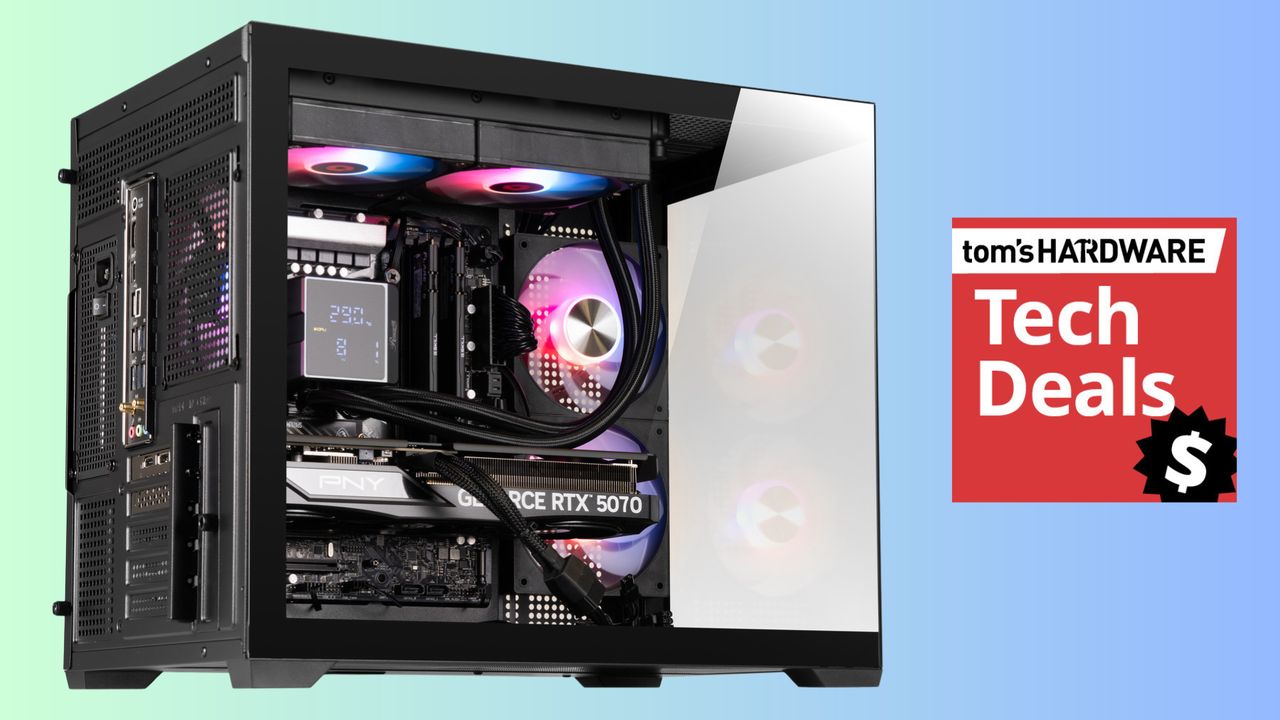
Newegg has discounted an ABS Flux II Aqua pre-built desktop featuring an Nvidia GeForce RTX 5070, a 20-core Intel CPU, 32GB of DDR5 RAM, and a 1TB SSD by $300 to $1,999.99. While marketed to consumers for 1440p and 4K gaming, sub-$2,000 pricing on latest-generation GPU systems carries broader strategic implications for enterprise hardware procurement and edge AI workflows.
Across global enterprise IT, rising cloud API expenses and strict data residency mandates are pushing engineering teams to shift AI prototyping, small-model fine-tuning, and retrieval-augmented generation testing onto local machines. Historically, provisioning dedicated workstations with current-generation accelerators required lengthy vendor lead times and steep capital expenditure premiums. Pre-built configurations breaking the $2,000 threshold alter this equation. System integrators and mid-market software firms can procure capable CUDA-enabled developer nodes off the shelf, bypassing volatile standalone component markets and accelerating local agentic AI experimentation without inflating cloud compute budgets.
This shift also pressures traditional enterprise OEMs, whose certified workstation lines often carry substantial markups for comparable compute specifications. As consumer-grade pre-built desktops pair multi-core Intel processors and fast DDR5 memory with current Nvidia architectures at aggressive price points, startups and research divisions increasingly treat gaming-tier hardware as pragmatic developer infrastructure. The primary trade-off remains fleet manageability, warranty service levels, and thermal reliability in dense office deployments—areas where IT leaders must weigh upfront capital savings against operational support overhead.
For Japanese enterprises, SIers, and domestic development studios, global price compression on RTX 5070 desktops highlights a growing procurement dilemma. Currency headwinds and multilayered domestic distribution margins frequently keep Japanese retail hardware prices elevated long after US retailers initiate promotional discounting. However, Japanese corporations maintain strong preferences for on-premise execution when deploying AI-assisted RPA, document processing, and internal coding assistants due to stringent corporate governance and client confidentiality standards. For mid-sized SIers and regional engineering teams, monitoring sub-$2,000 benchmark configurations helps calibrate domestic hardware refresh budgets. Procuring high-spec local GPU desktops allows Japanese development teams to test quantized open-weight models internally before committing to costly enterprise cloud contracts or custom data center allocations.




