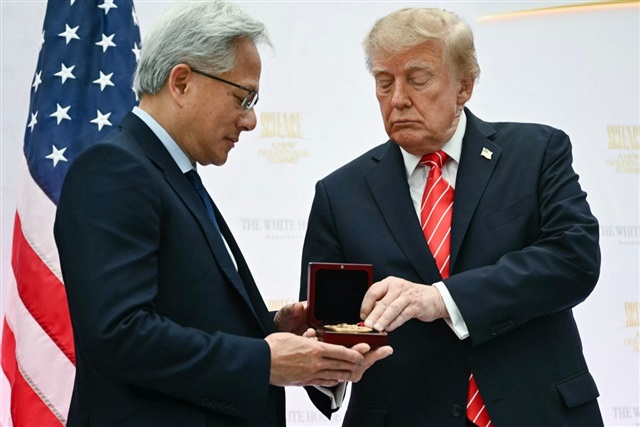
A personal scandal has turned into a governance and national-security question at the most important company in the AI economy. Nvidia's board ordered an independent investigation into whether Jensen Huang was the target of a foreign intelligence operation, after Huang told staff in a memo that he had been unfaithful to his wife and US officials flagged the woman involved as a suspected agent for China. President Trump's quick public statement that Huang should keep his job tells you the stakes are political as much as corporate.
The real exposure here is concentration. Nvidia's valuation, product roadmap, and relationships with hyperscalers and governments are fused to one founder-CEO to a degree rare even among tech giants. An investigation that touches China ties and export controls is combustible precisely because Nvidia sits at the choke point of global compute, and because Washington already scrutinizes every path its GPUs take toward Chinese buyers. Reporting that the individual involved purchased GPUs in bulk, if substantiated, moves this from a reputational story to a compliance and diversion-risk story that regulators on both sides of the Pacific will watch closely.
For boards everywhere, the lesson is unglamorous: founder-CEOs whose personal conduct can trigger security reviews need real succession depth and independent oversight, not deference. Markets have priced Nvidia as if Huang is irreplaceable. That assumption is now being tested in public.
For Japan, the dependency is direct and uncomfortable. SoftBank, the major cloud operators, and a widening set of enterprises building generative-AI platforms rely on Nvidia allocation that is already supply-constrained. Any leadership instability, or tighter US export enforcement spilling out of this probe, flows straight into GPU lead times, pricing, and the build schedules of Japanese data centers. SIers architecting AI infrastructure for banks, manufacturers, and the public sector should treat single-vendor GPU reliance as a live risk and accelerate evaluation of alternative accelerators and cloud-abstraction layers, even if Nvidia remains the default.
There is also a compliance dimension for Japanese distributors and system integrators that resell or deploy high-end accelerators. Heightened US attention to how advanced chips reach China raises the bar on export-control diligence across the entire reseller chain in Asia. The governance angle lands close to home too: Japan's founder-led tech firms, often built around a dominant figure, should read this as a reminder that key-person risk and independent board capacity are strategic assets, not box-ticking.




