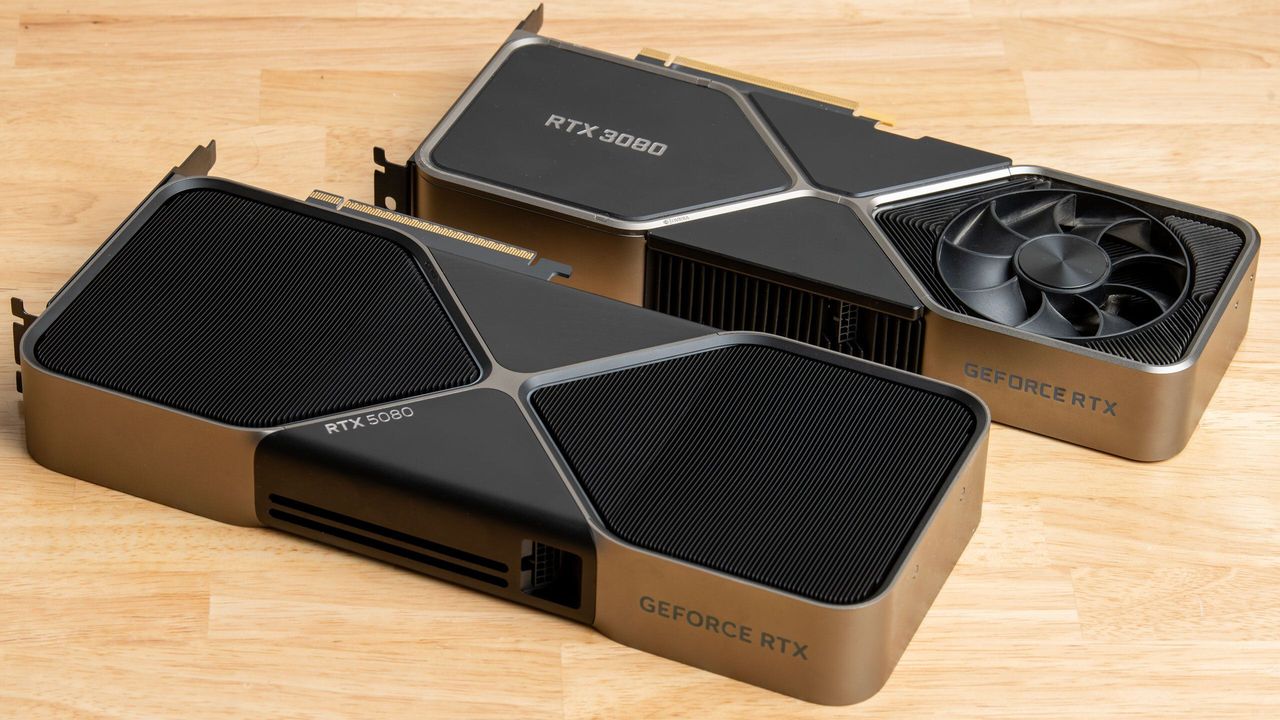
The $999 launch price for Nvidia's RTX 5080 has become a historical footnote. Street prices around $2,000 now exceed what the flagship RTX 5090 cost at launch, and the distortion runs up the stack: the workstation-class RTX PRO 6000 is quoted near $16,000, pricey enough that a complete Dell Pro Max Tower T2 built around it sells for roughly $2,000 less than the bare card. When a finished system undercuts one of its own components, the channel is no longer pricing on value; it is pricing on scarcity.
The mechanism is memory, not silicon. With hyperscaler AI buildout absorbing capacity at record scale, memory makers are steering wafers toward high-margin HBM for data-center accelerators, thinning supply of the GDDR used on consumer and prosumer boards. Add-in partners pay more per module and pass it through, so the gap between MSRP and retail widens with every quarter the shortage persists. The practical result is that gaming GPUs are drifting into luxury territory while the components that matter for local AI work command data-center-style premiums.
For global buyers the strategic takeaway is that the on-prem versus cloud math has flipped again. Capex-based GPU procurement now carries both price inflation and allocation risk, strengthening the case for rented cloud capacity, except that the same demand surge is tightening cloud instances too. Expect gray-market arbitrage, bundling games, and longer lead times to persist well into the shortage cycle.
For Japanese enterprises and SIers the pressure is sharper because a weak yen stacks on top of dollar-denominated inflation. Infrastructure estimates written for AI proof-of-concept projects in 2024 are now unreliable; a workstation line item can swing by hundreds of thousands of yen, and fixed-price integration contracts that assumed stable hardware costs will erode margins. SIers should re-quote on current street prices, not MSRP, secure allocation early with distributors, and present cloud GPU rental as a hedge rather than a default. Local development teams doing on-device inference, rendering, or CAD should assume refresh cycles stretch out, while RPA and conventional back-office automation, which lean on commodity CPUs, stay largely insulated. The firms that treat GPU supply as a procurement and scheduling problem, not a spec-sheet choice, will protect both budgets and delivery timelines.




