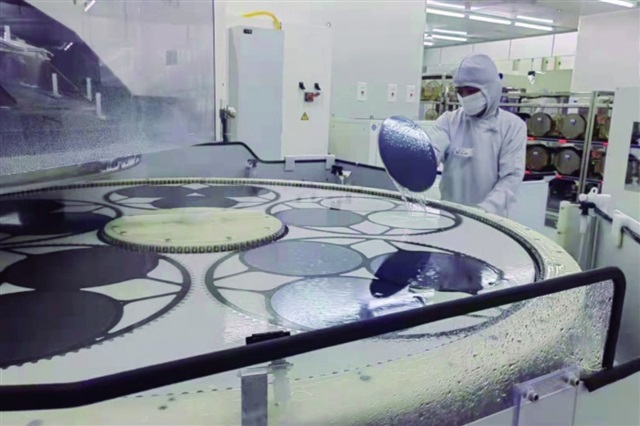
Haitao Jiang's departure from all roles at National Silicon Industry Group is more than a corporate reshuffle. NSIG sits at the foundation of China's semiconductor self-sufficiency drive as one of the few domestic players attempting large-diameter silicon wafer production at scale. Leadership transitions at companies this early in their technology maturation curve carry outsized risk, because the strategic relationships, capital-allocation bets, and government alignment that define such firms tend to be personality-driven rather than institutionalized.
The global read is straightforward. Silicon wafers remain a chokepoint dominated by Japan's Shin-Etsu and SUMCO, plus a handful of German and Taiwanese suppliers. Beijing has poured state capital into closing that gap precisely because wafers are upstream of everything, immune to node-level workarounds. Any wobble in NSIG's execution cadence extends the window during which China stays dependent on imported substrate, which in turn strengthens the leverage of incumbent suppliers and the export-control regimes that police them. Investors watching China's localization thesis should treat governance continuity as a leading indicator, not a footnote.
For Japanese enterprises, this is quietly consequential. Shin-Etsu and SUMCO together anchor a segment where Japan still holds durable structural advantage, unlike lithography or EDA where the country ceded ground. A stumble at NSIG effectively lengthens the runway for that advantage. The strategic question for Japanese materials firms is whether to press pricing power now or invest through the cycle to make the moat unbreachable before China's next generation of leadership stabilizes execution.
Japanese SIers and enterprise IT planners should read this through a supply-resilience lens rather than a stock-picking one. Firms building semiconductor-adjacent systems, from fab automation to yield analytics, need to model a world where China's substrate localization arrives later and messier than official timelines suggest. That argues for continued design dependence on Japanese and Taiwanese wafer sources in the medium term, and for procurement teams to avoid over-indexing on projected Chinese capacity that hinges on unproven leadership.
The broader lesson is that in strategically critical, capital-intensive materials businesses, human-capital continuity is a national-security variable. Markets price technology roadmaps well and leadership fragility poorly. NSIG is a reminder that the two are inseparable at the frontier of industrial policy.




