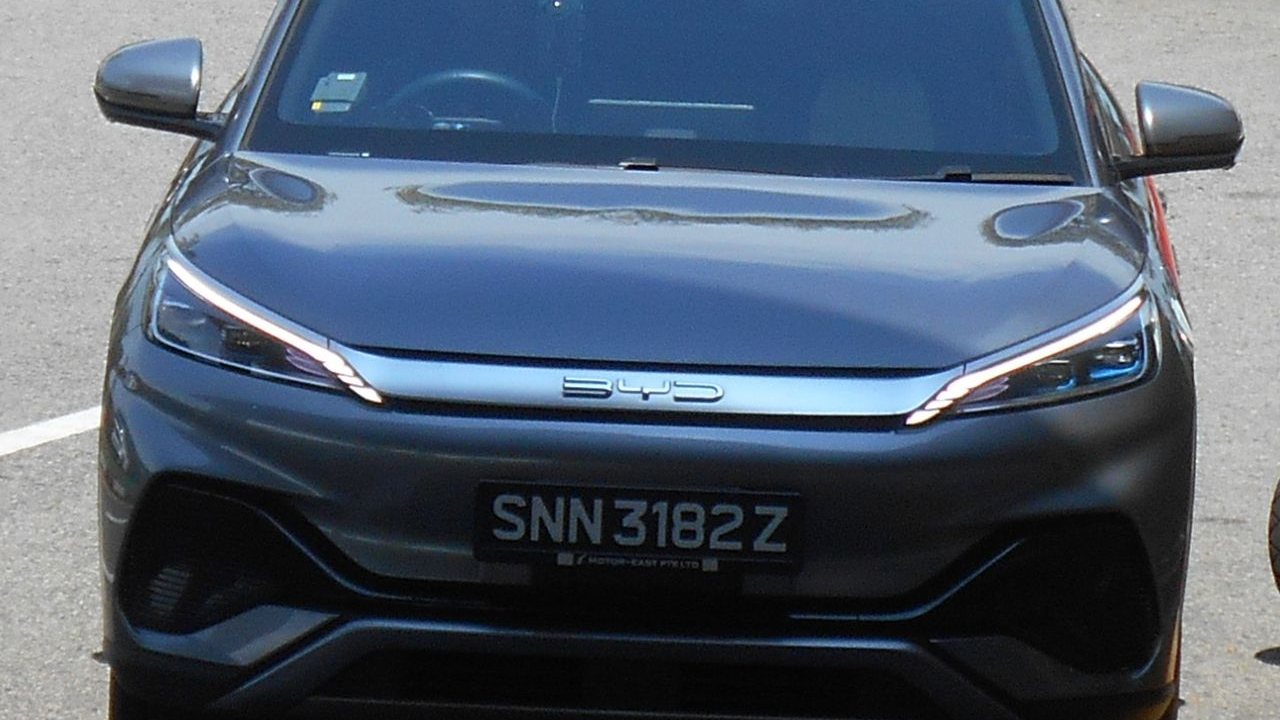
BYD overtaking Toyota in quarterly revenue for the first time, with annual volume nearing 7 million units and ~30% of sales now outside China, marks more than a leaderboard reshuffle. It confirms that the economics of carmaking have shifted beneath the industry's feet.
The decisive variable is vertical integration. By owning semiconductors, batteries, and assembly end-to-end, BYD has built an estimated 15–20% structural cost advantage over the traditional keiretsu sourcing model. This is not a temporary subsidy artifact—it is an architectural edge that compounds as volume scales. Legacy OEMs relying on tiered, arms-length supplier networks face a margin gap they cannot close through incremental efficiency alone; it requires re-platforming the entire production stack.
The exposure is uneven. Toyota's hybrid franchise (roughly 40% global HEV share) keeps North American profits resilient near-term, but its ASEAN stronghold—long around 30% share in Thailand and Indonesia—is being directly contested by BYD's Atto 3 and Seal. Nissan and Honda, already bleeding in China, will meet tougher EU CO2 rules from 2027 with thin BEV portfolios. A genuine counterattack demands a 5-million-unit dedicated BEV platform, an investment north of $20 billion.
For suppliers the calculus is sharper. Tier-1s with 40–60% dependence on a single anchor OEM inherit that OEM's transition lag as direct earnings risk. The viable pivots: direct supply to Chinese OEMs (BYD, Geely, Chery), EV-specific products—eAxles, SiC inverters, thermal modules—sold to Western OEMs, and software-defined-vehicle middleware. Nidec already holds 20%+ in China-bound eAxles, proving keiretsu loyalty is no longer a survival strategy.
The overlooked upside sits in the picks-and-shovels layer. BYD Semiconductor's plan to triple automotive power-chip capacity by 2027 is a tailwind for equipment makers (Tokyo Electron, Disco, SCREEN), materials suppliers (Shin-Etsu, SUMCO), and passive component leaders (Murata, TDK). Investors should rotate toward suppliers diversifying beyond legacy anchors and exposed to Chinese EV capex—and treat BYD's quarterly lead not as a warning shot, but as confirmation the structural shift has already arrived.




