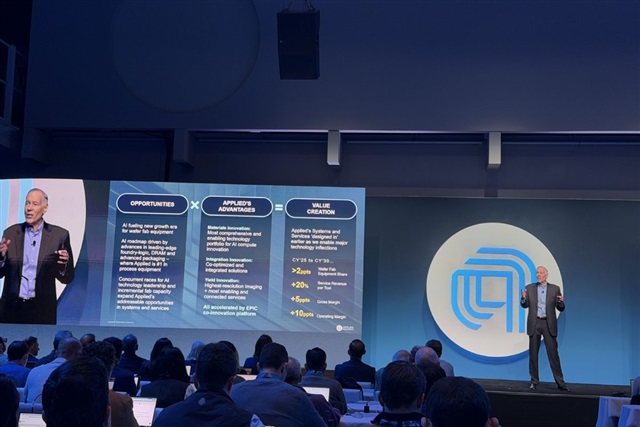
When the head of the world's largest chip-equipment maker calls demand the strongest of his career, it is worth parsing what that signal actually means. Applied Materials is pointing to two distinct pressures: squeezing more usable dies out of each wafer, and adding raw wafer capacity at speed. Both are being forced by AI compute, where chips are enormous, yields are punishing, and every point of defectivity translates directly into margin at the hyperscaler level. The strategic takeaway is that the AI boom's economics are migrating upstream. The headline spend is on GPUs and datacenters, but the durable, structurally advantaged layer is the equipment and process-control toolchain that determines whether those chips can be built at all.
A guided 20%-plus growth trajectory over several years, if it holds, implies the capex supercycle is not a one-year spike tied to a single model generation but a multi-year re-tooling of global fabs. That reframes the risk picture. The near-term question is no longer whether AI demand exists, but whether it concentrates in a handful of leading-edge nodes or broadens into trailing-edge and advanced-packaging capacity. Yield and inspection tools benefit either way, which is why process control is becoming the defensible high ground of the semiconductor economy.
For Japan, this is one of the cleaner read-throughs in the current cycle. The country's strength is precisely in the picks-and-shovels layer that benefits most. Equipment names in deposition, etch, cleaning, test, and dicing, alongside the materials base in silicon wafers and photoresist, are positioned to ride the same demand curve Applied Materials is describing, often as complements rather than direct competitors. A sustained tool-buying cycle flows straight into Japanese order books and, importantly, into high-value service and spare-parts revenue that smooths the historical boom-bust volatility of the sector.
Japanese enterprise buyers and SIers should read this as a supply-side constraint on their own AI roadmaps. If leading-edge and packaging capacity stays tight, the cost and availability of AI accelerators remains volatile, which strengthens the case for workload optimization, inference efficiency, and hybrid cloud strategies over brute-force compute procurement. For domestic foundry ambitions, the message is that competitiveness will hinge less on fab announcements and more on securing a stable, prioritized position in a global equipment queue that is now running hotter than it has in decades.




