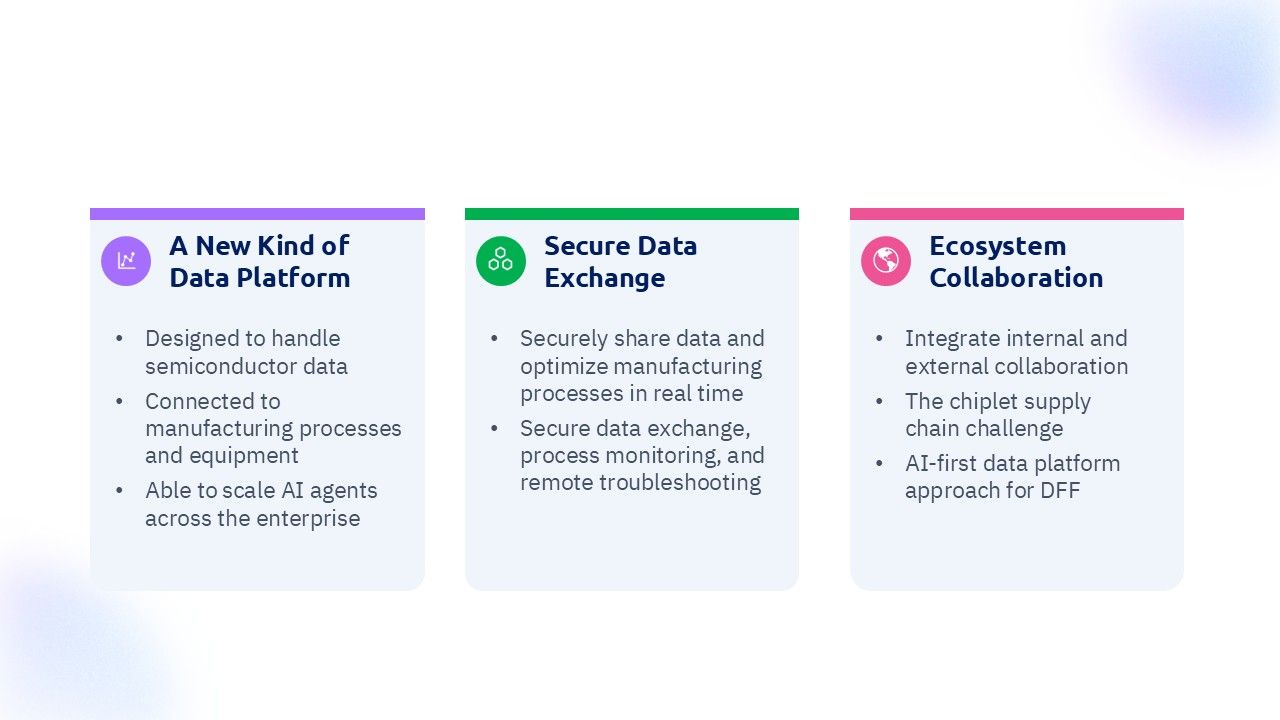
At an ESD Alliance program at SEMICON West, PDF Solutions presented an AI-first platform concept for a semiconductor industry with increasingly distributed design and manufacturing.
The strategic issue is not whether chip companies can add another prediction model. It is whether they can turn fragmented design, process, test and field data into a trusted operating system for decisions. As semiconductor production is spread across specialized partners, the competitive asset shifts from any single tool to continuity of evidence across handoffs. AI can expose patterns in yield, reliability and design intent, but only when the underlying data has common meaning, provenance and permission controls.
That creates a platform contest with two possible outcomes. A narrowly optimized application may produce a quick gain in one workflow while leaving the organization with another isolated model. A shared layer can support root-cause analysis, design-for-manufacturability feedback, process monitoring and qualification—provided it can reconcile incompatible schemas and preserve engineering context. The commercial challenge is equally important: an AI-first platform must earn trust from parties that collaborate operationally while competing commercially. Data-sharing boundaries, model ownership, auditability and protection of customer IP become product requirements, not legal afterthoughts.
For semiconductor executives, the investment test should be measured in closed-loop decisions rather than model count. Can a defect signal change a design rule? Can a manufacturing observation inform the next tape-out? Can an engineer verify why an AI recommendation was made and reproduce it later? Platforms that answer those questions can reduce the cost of fragmentation; those that merely place a conversational interface over existing repositories will add another layer of complexity. The winning architecture is likely federated: local data remains under operational control while shared semantics and carefully governed models travel across organizational boundaries.
For Japan, this is a direct enterprise-software opportunity as much as a semiconductor one. Japanese chipmakers, materials companies, equipment suppliers and manufacturing partners often operate through dense networks of internal divisions and external counterparties. Their constraint is not simply access to AI; it is stitching together legacy production systems, engineering databases and quality processes without disrupting qualified operations. A platform that provides traceability and controlled interoperability could become a bridge between established factories and newer AI workflows.
Japanese SIers should avoid positioning themselves only as migration contractors. They can differentiate by building domain data models, access policies, MLOps controls and human escalation paths around semiconductor workflows. RPA teams also have a role, but automation should target administrative seams—handoff validation, exception routing and evidence collection—rather than disguise weak data foundations. Local development teams should pilot one closed loop with clear ownership, then standardize reusable connectors and evaluation criteria. The strategic prize is not an AI demonstration; it is durable integration infrastructure that makes Japan’s distributed industrial base easier to improve without surrendering control of its data.




