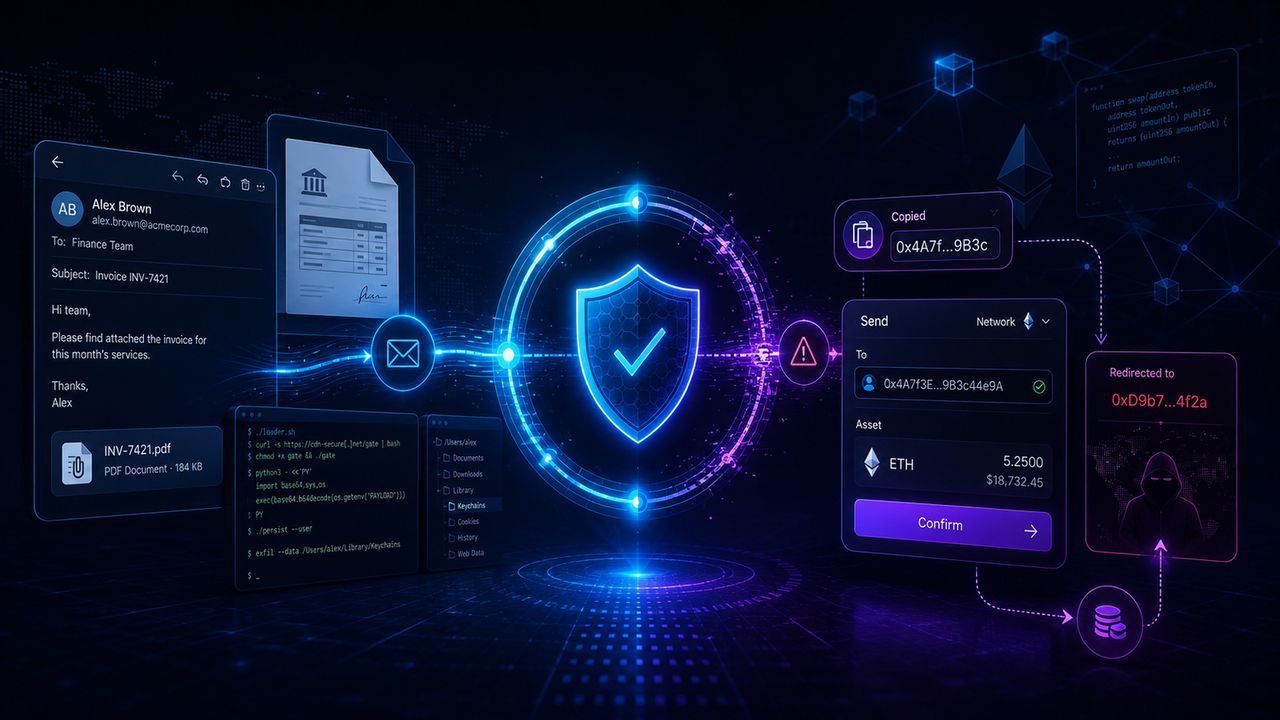
A new threat report details two payment-theft chains: one weaponizing compromised business inboxes plus browser manipulation to drive banking malware, the other silently swapping crypto wallet addresses via clipboard hijacking. The mechanics differ; the strategy is identical.
The strategic shift is from breaking systems to borrowing trust. Legacy detection assumes attackers arrive as outsiders—strange domains, unsigned binaries, anomalous logins. But a hijacked real inbox carries authentic headers, prior thread history, and a colleague's reputation. A manipulated live browser session inherits valid cookies and MFA state. Clipboard hijacking never touches the bank at all; it edits the destination a human already trusts. Every control built to spot the fake is blind to the genuine channel turned against its owner.
The economic target is telling: both chains monetize at the payment step, not the data-exfiltration step. This is the maturing of fraud economics—stolen data must be fenced through intermediaries, but a redirected wire or wallet transfer is instant, final, and increasingly irreversible in crypto. For CFOs and treasury teams, this reframes the loss model from breach-disclosure liability to direct cash leakage, a P&L item boards understand immediately.
Opportunity sits with vendors who move verification to the transaction layer rather than the perimeter. Expect momentum for out-of-band payment confirmation, address allowlisting with cryptographic pinning, and browser-isolation plays from Cloudflare, Zscaler, and Island. Okta and Microsoft face pressure to treat session hijacking, not just credential theft, as the primary identity threat. Chainalysis-style wallet-screening will extend from exchanges into corporate treasury tooling.
Recommended actions: mandate dual-channel approval for any payment-detail change, deploy clipboard-integrity checks on finance endpoints, and stress-test whether your fraud controls assume the sender is fake. The uncomfortable executive takeaway—your strongest authentication now protects the attacker's session as faithfully as your own. Audit for trust-abuse, not just intrusion.




