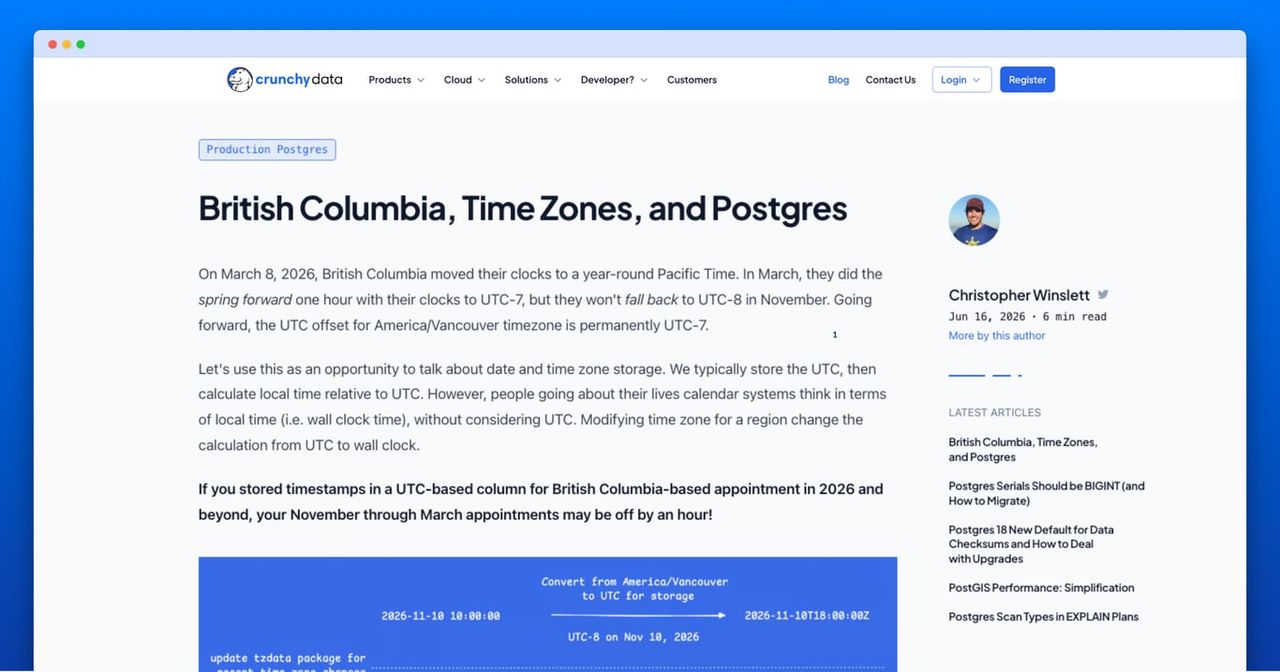
A deceptively dry topic—how a database like PostgreSQL handles a region abandoning daylight saving—exposes a systemic fragility in global software. Time zones are not physics; they are political decisions, and they change with little warning. When British Columbia, the EU, or any government alters its clock rules, every system relying on stale time-zone data silently produces wrong timestamps for scheduling, billing, audit logs, and compliance records.
The strategic point for executives: your most boring infrastructure carries unpriced operational risk. Time-zone definitions ship via the IANA tz database, maintained by a tiny volunteer-driven community and bundled into operating systems, language runtimes, and databases. A change can take months to propagate across your stack. For a fintech reconciling cross-border trades, a healthtech timestamping prescriptions, or a logistics platform coordinating fleets, a one-hour error is not cosmetic—it triggers failed SLAs, mispriced contracts, and regulatory exposure.
The broader pattern is dependency on invisible, undercapitalized public goods. The tz database, like OpenSSL before Heartbleed or core open-source maintainers generally, underpins trillions in economic activity while running on goodwill. Boards that obsess over supply-chain resilience in silicon rarely audit the software supply chain of foundational data. That asymmetry is a governance gap.
Recommended actions: store timestamps in UTC and convert at the presentation layer rather than baking local offsets into stored data; treat tz database updates as a tracked, tested deployment event, not an OS afterthought; and add jurisdictional time-rule changes to your regulatory monitoring. Cloud providers—AWS, Google Cloud, Azure—abstract much of this, but the liability still sits with the application owner.
The meta-lesson echoes today's larger infrastructure debates, from AI power contracts to chip supply: competitive advantage increasingly hinges on mastering the unglamorous, dependency-laden layers others ignore. Correctness at the foundation is cheaper than litigation at the top.




