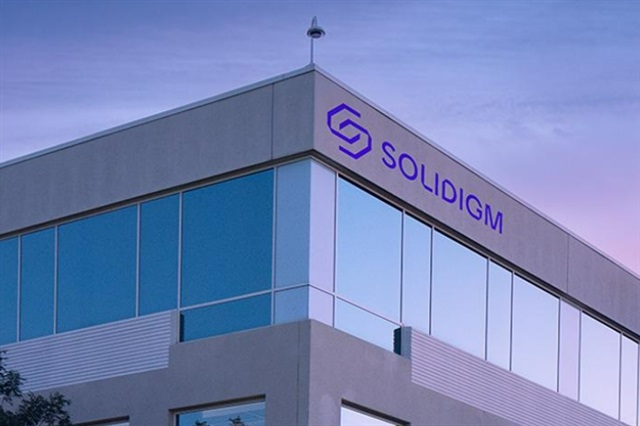
Solidigm, the NAND unit SK Hynix absorbed from Intel, is weighing a US wafer fab, with funding and timing still open. The decision reads less like a routine capacity plan and more like a bet that NAND has rejoined the strategic tier of the AI buildout, where HBM and advanced logic already sit.
For most of the past decade NAND was the commodity floor of the memory market, prone to brutal price cycles and overcapacity. AI training and inference clusters are changing the shape of that demand. High-capacity enterprise SSDs now sit between hot GPU memory and cold archival tiers, and the volumes required to feed large data-center fleets are pulling NAND into the same supply-security conversation that reshaped logic. A US fab would let Solidigm court American hyperscaler contracts, qualify for domestic-content preferences, and hedge against the tariff and export-control volatility that now surrounds anything made in Asia. The open question is economics: NAND margins do not easily cover US construction and operating costs without subsidy, which is why the funding uncertainty is the story, not a footnote.
The competitive frame matters too. SK Hynix has prioritized HBM, where it leads, and a NAND fab competes for the same capital and government attention. Committing to US NAND signals confidence that AI storage demand is durable rather than a one-cycle spike, and it raises pressure on Samsung and Micron to match the onshoring move.
For Japan, the direct stakeholder is Kioxia, the country's flagship NAND producer and a structural rival to Solidigm. A subsidized US competitor would squeeze Kioxia precisely as it rebuilds financial footing, and Tokyo may face its own pressure to backstop domestic memory capacity rather than cede the enterprise-SSD segment to US-based supply.
For Japanese enterprises and SIers, the practical effect lands in procurement and architecture. Storage lead times and pricing for AI and data-platform projects will increasingly track geopolitics, not just spot-market cycles. SIers scoping on-premise AI, RPA data stores, and hybrid-cloud migrations should treat NAND sourcing as a supply-chain risk to model explicitly, build multi-vendor qualification into designs, and advise clients that cheap, abundant enterprise SSDs can no longer be assumed. The teams that plan storage capacity as a strategic input, rather than a line item, will quote AI infrastructure more accurately than those still pricing off last cycle's commodity logic.




