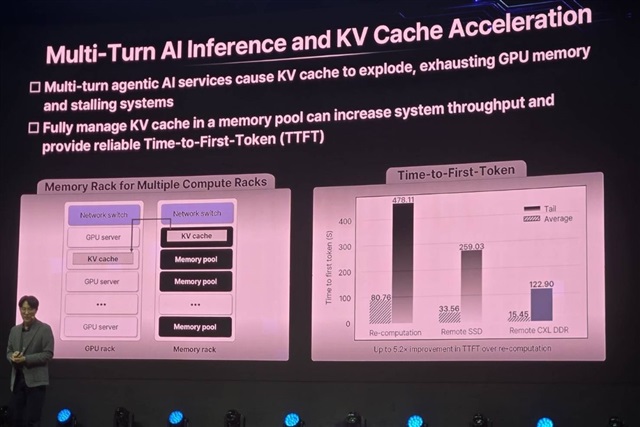
SK Hynix and Intel are collaborating with ecosystem partners on memory-centric server architectures—leveraging interconnects like Compute Express Link (CXL)—to pool memory across AI clusters as agentic workloads strain bandwidth and capacity. Moving beyond this engineering milestone, the timing reflects a pivotal shift in the economics of global AI infrastructure. For the past cycle, hyperscalers solved capacity bottlenecks through brute-force procurement, buying entire high-margin GPU servers simply to access attached High Bandwidth Memory (HBM). That blank-check era is encountering friction. With major financial institutions questioning the return on AI infrastructure buildouts and telecom operators like SoftBank's mobile arm flagging potential slowdowns in US AI datacenter demand, Chief Financial Officers are demanding higher utilization from existing silicon.
Agentic AI compounds this architectural and financial tension. Unlike stateless chatbots, autonomous multi-step agents require persistent context windows, long-term state retention, and rapid memory handoffs across disparate compute nodes. Tying memory strictly to individual processors leaves vast pools of DRAM stranded on idle hosts while starving active inference nodes. By decoupling memory from compute, SK Hynix and Intel are positioning CXL-based memory pooling as a structural hedge against capex fatigue: datacenter operators can scale capacity independently without over-provisioning expensive accelerators. For Intel, championing open memory-pooling standards also provides a strategic wedge against proprietary, vertically integrated interconnects that lock buyers into single-vendor server racks.
For the Japanese market, where domestic cloud providers, telecom carriers, and enterprises face acute power constraints and yen-denominated hardware inflation, disaggregated memory alters the infrastructure playbook. Japanese datacenters—heavily concentrated around Tokyo and Osaka with tight megawatt ceilings—cannot afford low-utilization server sprawl. Major Japanese system integrators (SIers) designing sovereign cloud environments and on-premises enterprise AI clusters will need to rethink hardware sizing. Instead of pitching monolithic GPU appliances for internal RPA replacements and multi-agent enterprise workflows, SIers can architect modular, memory-heavy topologies that extend hardware depreciation cycles.
Local Japanese development and infrastructure teams building stateful enterprise agents must also adapt at the software layer. Shared memory pools introduce non-uniform latency tiers compared to local HBM, meaning engineering teams and SIer middleware practices will need to optimize key-value cache placement and memory orchestration to extract real cost savings without degrading agent response times.




