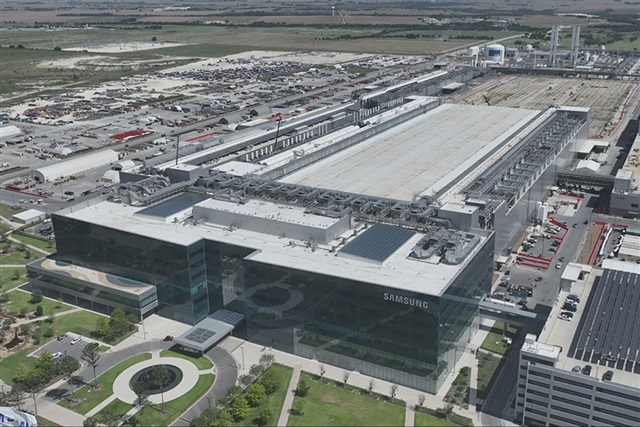
Samsung reportedly plans to fabricate HBM base dies for AMD at its second Taylor, Texas plant, with AMD taking most of the capacity and Nvidia cited as a possible second customer. Neither order is confirmed.
The strategic point is the base die, not the memory stack itself. As HBM moves toward HBM4, the logic base die at the bottom of the stack shifts from a passive interposer-like layer to a performance-defining component that benefits from an advanced logic process. That reframes the competition: it is no longer only a DRAM contest between SK Hynix, Samsung, and Micron, but a question of which foundry process sits under the stack. By making the base die on its own advanced node and pairing it with its DRAM, Samsung is trying to turn a weakness, a foundry business that has struggled to win marquee customers, into an integrated selling point against SK Hynix's lead with Nvidia.
For AMD, routing base die production through Samsung's US fab serves two goals at once: securing a second HBM source as it scales the MI accelerator line against Nvidia, and building geographic supply resilience as Washington presses for domestic advanced packaging and memory content. Nvidia's hesitation is equally telling. It has little reason to dilute a working SK Hynix relationship unless Samsung proves yield and reliability first, which is why AMD becomes the anchor tenant that lets Samsung build a track record.
For Japan, the read-through runs through the materials and equipment layer rather than chipmaking. Base die and HBM output scaling lifts demand for the photoresists, precision chemicals, bonding and inspection tools where Japanese suppliers hold strong positions. The Fujifilm tape-capacity expansion in today's cycle and this HBM push point the same direction: AI is pulling investment into every tier of the memory and storage stack, and that spending flows disproportionately to specialized Japanese inputs regardless of which foundry or memory vendor wins the socket.
For Japanese enterprises and SIers, the practical signal is supply diversification in the accelerator market. If AMD gains a credible second HBM source, buyers of AI infrastructure gain negotiating leverage and a hedge against Nvidia allocation constraints. SIers designing on-premise or hybrid AI build-outs for regulated Japanese clients should track AMD's accelerator roadmap more seriously, and treat single-vendor GPU dependence as a procurement risk to plan around rather than accept by default.




