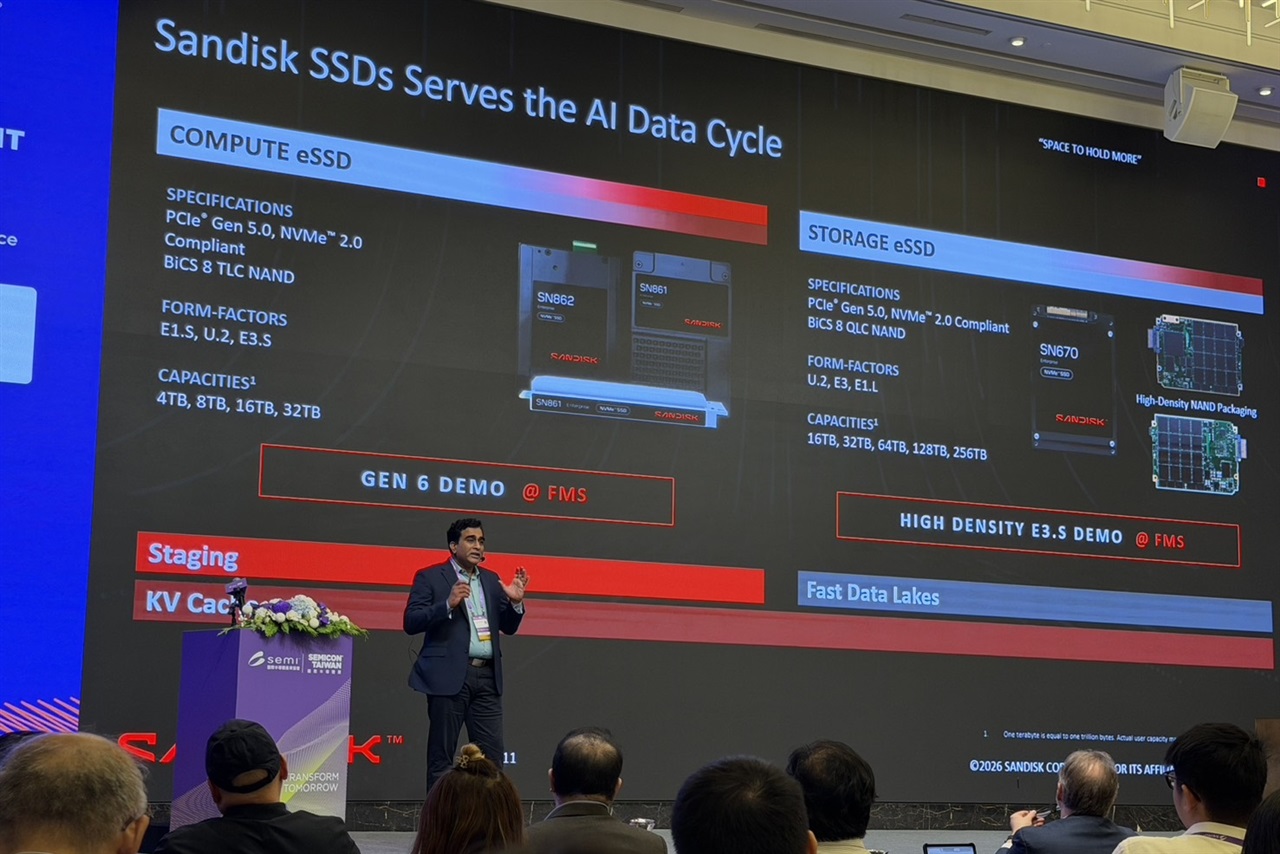
Sandisk says AI infrastructure customers are returning for more NAND flash after underestimating their storage needs, with a pipeline of long-term supply agreements that exceeds planned output through the end of the decade. The signal matters more than the single vendor: storage has quietly become a second bottleneck in the AI buildout, behind GPUs and high-bandwidth memory but tightening fast.
The market has fixated on compute. Yet training runs generate enormous checkpoint data, retrieval-augmented inference leans on fast local storage, and the raw corpora feeding models keep growing. Buyers sized their first datacenters around accelerators and discovered the data tier was undersized. That the supply-agreement pipeline now outruns planned capacity is the real news. It tells you memory makers, burned by the 2023 oversupply crash, are holding capex discipline rather than chasing volume. Scarcity, not a demand surge alone, is restoring pricing power to suppliers. Expect firmer NAND pricing, longer lead times, and a shift from spot buying to multi-year commitments that favor hyperscalers able to pre-pay and lock allocation. Smaller cloud and enterprise buyers risk being crowded out of the queue.
For Japan, the most direct exposure runs through Kioxia, the country's domestic NAND producer and a central node in global flash supply. A structurally tighter market strengthens its hand on pricing and long-term contracts, but also raises the strategic stakes of its fab investment pace. Underinvest and it cedes AI-era allocation to rivals; overbuild into a cyclical peak and it repeats the industry's familiar boom-bust.
For Japanese SIers, datacenter operators, and enterprise IT teams, the practical message is procurement risk. Storage cost and availability should now enter AI infrastructure planning as a first-order variable, not an afterthought bolted on after the GPU order. Teams building on-premises or sovereign AI environments, a growing requirement in Japanese finance and the public sector, will feel longer lead times most acutely. The sensible response is to forecast storage demand per workload early, negotiate allocation ahead of deployment, and treat multi-year supply terms as a competitive advantage rather than a formality.
The broader pattern is that AI scarcity migrates down the stack. First GPUs, then HBM, now NAND, and power and cooling after that. Each bottleneck rewards buyers who plan the full bill of materials in advance and penalizes those who treat compute as the only constraint worth managing.




