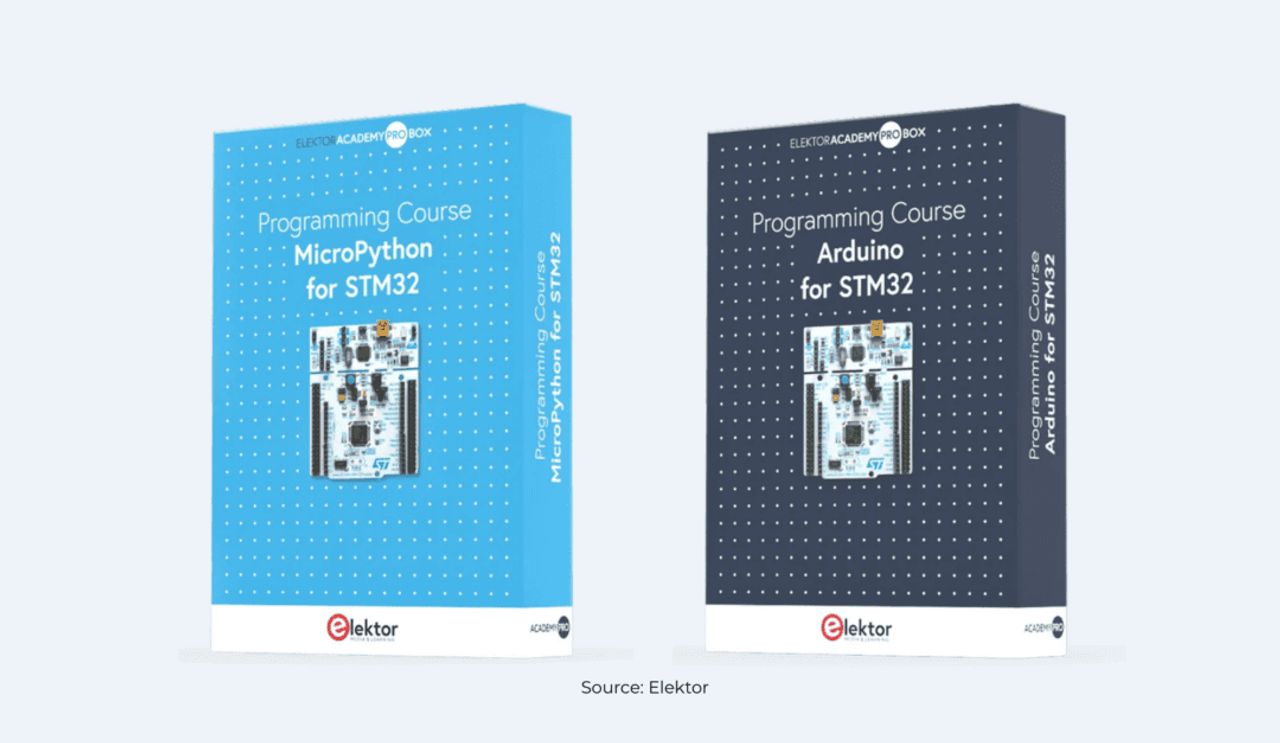
A pair of new Elektor Academy Pro courses teaching STM32 microcontrollers via MicroPython or Arduino looks modest on the surface. The strategic signal underneath is larger: the long-standing wall between embedded firmware and mainstream software development is eroding, and the choice of entry language now carries real competitive weight.
For two decades, embedded work meant bare-metal C, vendor-specific toolchains, and a priesthood of specialists who understood registers and interrupt vectors. MicroPython and Arduino collapse that onboarding curve. A web developer or data scientist can now blink an LED, read a sensor, and prototype edge logic in an afternoon. Globally this matters because the center of gravity in hardware is shifting toward edge AI, battery-powered IoT, and devices that must run inference locally. The talent pool capable of building those products expands dramatically when the price of entry drops from months to days. STMicroelectronics benefits from any trend that pulls more developers onto its silicon, and the broader lesson for chip vendors is clear: developer experience is becoming as decisive as die performance in winning design sockets.
The tradeoff is equally real. Python-layer abstraction hides timing, memory, and power behavior that production embedded systems cannot ignore. The market is bifurcating into rapid prototyping in high-level languages and hardened C or Rust for shipping firmware. Teams that treat MicroPython as a learning gateway rather than a destination will capture the upside; those that ship interpreted code into constrained devices will hit walls.
For Japan the implication is acute. The country's industrial strength, from factory automation to automotive ECUs to precision instruments, rests on a generation of embedded C engineers now approaching retirement, and the pipeline behind them is thin. Lowering the barrier to microcontroller programming is one of the few credible routes to refilling that pipeline, letting web and application developers cross into hardware without a multi-year apprenticeship. Japanese manufacturers and the SIers serving them should treat tools like these as recruitment and reskilling infrastructure, not hobbyist curiosities.
There is also a near-term services angle. As edge-AI and IoT projects multiply, SIers face a shortage of staff fluent in both cloud backends and device firmware. Python-based embedded entry points let existing cloud and RPA-oriented teams extend down the stack toward the device layer, narrowing a staffing gap that has slowed many industrial IoT deployments. The firms that build internal training paths around these accessible toolchains will be positioned to bid on the hardware-plus-software contracts that pure software integrators cannot touch.