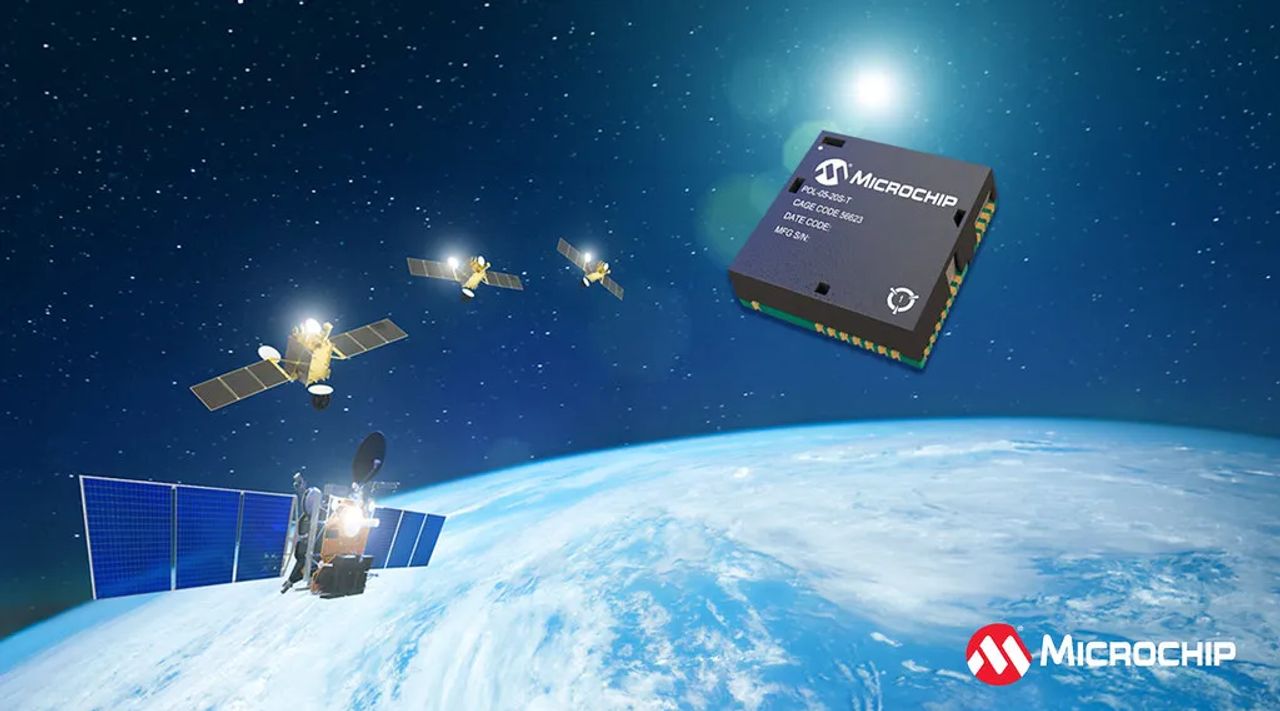
The headline fact is narrow: Microchip has added a radiation-tolerant GaN point-of-load converter, the POL-05-20S, rated to 20A, to its space power lineup. The strategic story is larger. Point-of-load conversion sits at the unglamorous base of every satellite's electrical architecture, and the shift from silicon to gallium nitride here is a tell about where orbital hardware is heading. GaN switches faster and runs cooler, which means more watts delivered per gram and per cubic centimeter. In space, where launch mass is the dominant cost variable and thermal budgets are brutal, that efficiency compounds directly into payload capacity and mission economics.
Globally, this is a supply-side response to the mega-constellation era. As operators push toward thousands of smaller, power-hungry spacecraft carrying phased-array antennas and onboard compute, the demand curve for compact, radiation-hardened power components steepens. Radiation tolerance is the gating feature: parts must survive total-dose and single-event effects without the bulk and cost of fully rad-hardened legacy silicon. Vendors who can offer GaN performance with proven radiation qualification capture a defensible niche, and the barrier to entry stays high because flight heritage and screening cannot be rushed. Expect the competitive front in space electronics to move away from raw digital compute and toward power, thermal, and packaging.
For Japan, the implications cut two ways. The country has deep GaN research roots and domestic power-semiconductor strength at Rohm, Toshiba, and Renesas, yet its space-grade and radiation-hardened component supply remains thin and import-dependent. With Japan's defense and space budgets expanding and projects spanning JAXA, Mitsubishi Electric, and NEC, reliance on US-sourced parts like these creates both a schedule risk and an export-control exposure that procurement teams should be modeling now.
The opportunity for Japanese manufacturers is to convert terrestrial GaN leadership into qualified space products rather than ceding the segment. For Japanese SIers and system houses building ground stations, satellite buses, and defense platforms, the practical takeaway is to treat power-component sourcing as a strategic, long-lead design decision, not a late-stage BOM line. Early qualification partnerships and dual-source strategies will matter more than headline chip specs.




