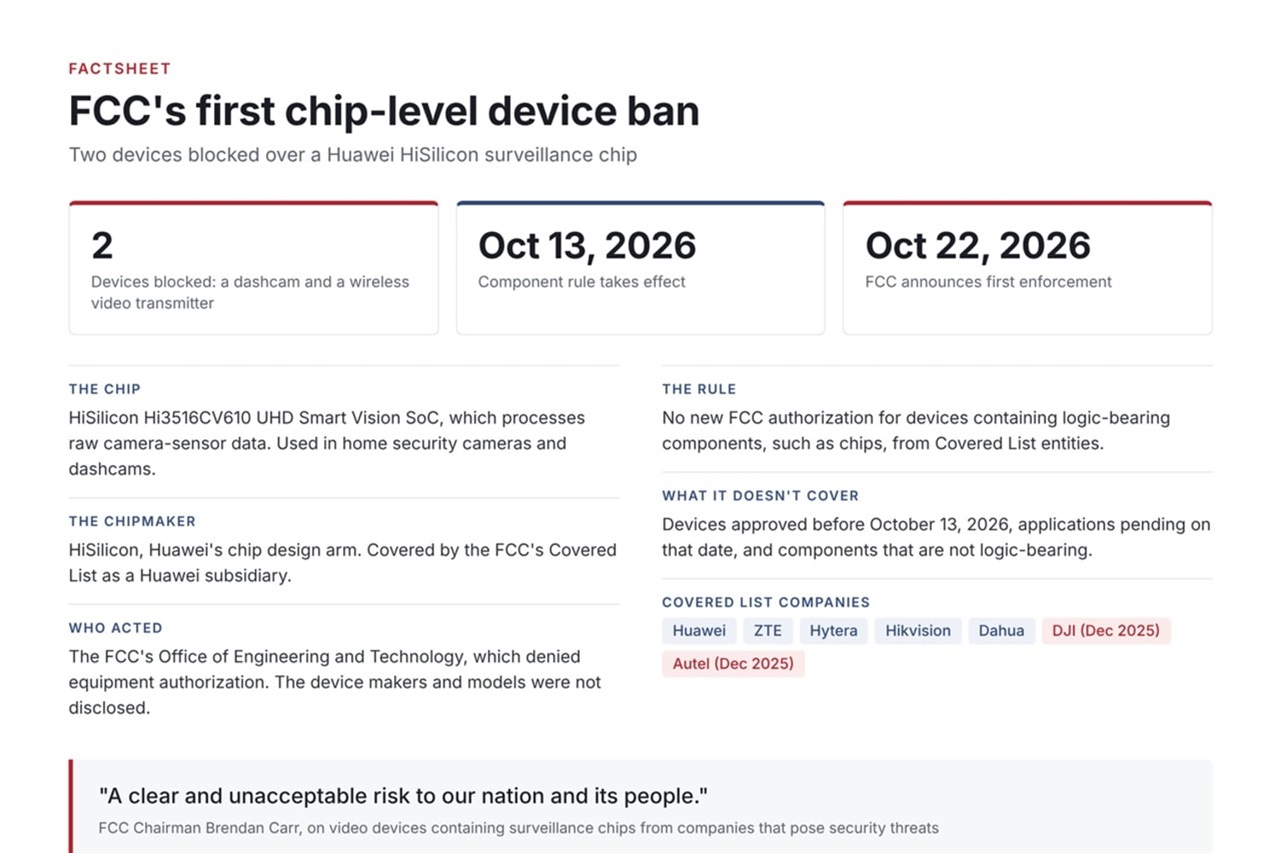
The FCC refused two devices entry to the US market because both carry Huawei HiSilicon chips, the first time it has invoked a rule that targets products whose chipmakers are designated national-security risks. The regulatory unit has quietly shifted from the finished product to the component inside it.
That shift changes the compliance burden. For years, export and import controls operated at the level of brand and entity: you checked whether the seller or the device model sat on a list. Enforcement now reaches a layer deeper, into who designed the silicon. A device from a clean vendor with a clean label can still be blocked on the strength of one controller buried in its bill of materials. Hardware makers that never audited provenance below the module level now have to, and the knowledge needed to do that lives in teardown labs and procurement records, not in legal departments.
The broader signal is that "designed-in" risk is becoming a durable category of regulation. HiSilicon parts are common in surveillance cameras, routers, and low-cost IoT modules, precisely the gear that gets white-labeled and resold under dozens of names. Expect the addressable scope of this rule to be far larger than two devices, and expect buyers to demand chip-level disclosure as a contract term rather than a nice-to-have.
For Japanese electronics makers and the SIers who integrate surveillance and IoT systems, this is a concrete operational problem, not a distant policy headline. Any firm shipping devices toward the US, or building systems for multinationals with US exposure, now needs chip-level traceability across camera fleets, building-management sensors, and network edge gear. Japan's own economic-security framework pushes in the same direction, so the compliance work is dual-purpose rather than a one-market tax.
The practical response for Japanese enterprise IT and development teams is to treat the bill of materials as auditable data. That means maintaining component-level inventories, scripting provenance checks into procurement and asset-management pipelines, and flagging designated chipmakers automatically rather than discovering them at a border. RPA and internal tooling fit this task well: reconciling vendor declarations against datasheets and teardown data is repetitive, high-volume, and exactly where automation earns its keep. The firms that build this capability now will absorb the next device ban as a routine query, not a shipment crisis.