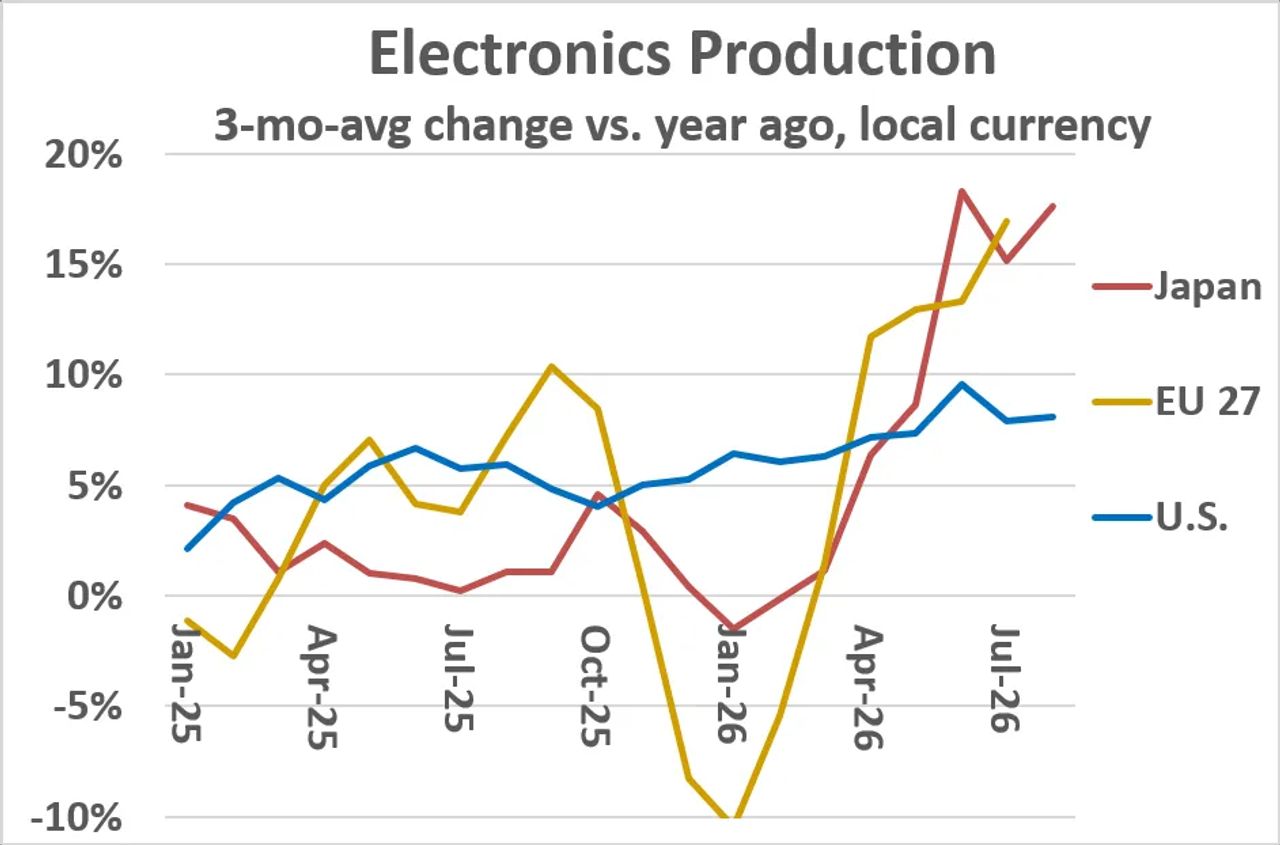
A production recovery is forming across the electronics stack, with U.S. output climbing 8.1% year-on-year on a three-month average basis in August 2026. The number matters less than its shape: growth that accelerates rather than spikes tends to reflect restocking plus genuine end-demand, not a one-off inventory correction. For the global industry, that distinguishes this cycle from the post-2022 hangover and suggests capacity planning, not caution, is becoming the default posture again.
The strategic risk is timing mismatch. Fabs, substrate suppliers, and assembly lines carry long lead times, so an upswing that looks modest in monthly data can turn into acute shortages in specific nodes and passives within two to three quarters. Firms that read the acceleration early gain pricing power; those that wait for confirmation inherit allocation queues. Expect renewed competition for mature-node capacity and advanced packaging, the two bottlenecks that repeatedly gate real-world production regardless of headline wafer supply.
For Japan, this cycle plays to structural strengths and exposes a familiar weakness. The country's grip on upstream materials, precision components, and packaging chemistry means a broad output rebound flows directly to names across the passive-component and equipment layers. A sustained demand curve is exactly the environment where Japanese suppliers compound advantage, provided they commit capital ahead of the signal rather than after it.
The weakness sits downstream, in how the rebound is operationalized. Japanese manufacturers still run production planning, procurement, and demand forecasting on fragmented systems stitched together by SIers, often with RPA bolted onto legacy ERP rather than genuine predictive integration. In an accelerating cycle, that latency is costly: the gap between a demand signal and a purchase order becomes the gap between capturing margin and missing it.
This is the opening for Japanese SIers to reframe their pitch. The value is no longer in automating back-office tasks but in building responsive supply-chain intelligence, AI-assisted demand sensing, inventory optimization, and supplier-risk modeling that turn a macro production print into factory-floor decisions. SIers that keep selling RPA seat-licenses will ride the cycle as order-takers; those that sell forecasting and resilience will define it. The rebound rewards speed, and in Japan speed is still mostly a software problem.




