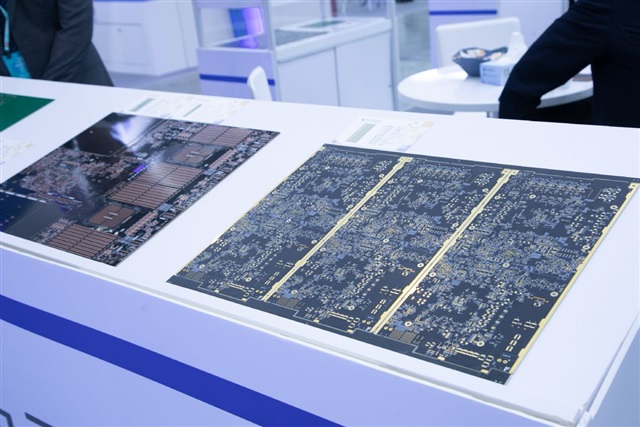
Beijing's new five-year industrial blueprint does something subtle but consequential: it elevates the humble printed circuit board from commodity component to strategic asset. By grouping PCBs, basic electronics, and energy electronics alongside semiconductors and advanced computing, China is signaling that the AI race will be won not only at the leading-edge node but across the entire physical stack that moves power and signal around a datacenter.
The logic is sound. As accelerated compute scales, the bottleneck shifts beyond the GPU to the materials and interconnect layers: high-layer-count PCBs, advanced substrates, power delivery, and thermal management. These are precisely the segments where China already holds deep manufacturing density and cost advantage. A revenue target above CNY30 trillion by 2030 is less a forecast than a declaration of intent to make the AI hardware supply chain structurally dependent on Chinese capacity, even as US export controls choke the top of the stack.
For global executives, this is the quiet counter-move to chip sanctions. You can restrict EUV tools and advanced logic, but you cannot easily reshore the thousands of mid-tier material and board suppliers that make an AI server actually function. The risk is a bifurcated supply chain where Western AI infrastructure remains exposed to Chinese substrates and PCBs at exactly the layers no one audited closely.
For Japan, the implications cut both ways. Japanese firms dominate critical upstream materials, ABF substrate chemistry, specialty laminates, and the precision chemicals that advanced PCBs cannot be built without. That is leverage. But it also makes Japan a target: a China determined to internalize the full electronics stack will push hard to localize these inputs, eroding a franchise Japanese materials makers have treated as defensible for decades.
For Japanese enterprises and SIers building AI datacenter and edge deployments, the strategic takeaway is supply-chain cartography. Procurement teams need to map not just chip sourcing but board, substrate, and power-electronics dependencies, because geopolitical risk now lives in components once considered interchangeable. SIers advising on sovereign AI and critical infrastructure should treat hardware provenance as a design requirement, not a purchasing afterthought. The companies that audit the physical layer now will avoid the scramble when the next export-control line is redrawn.




