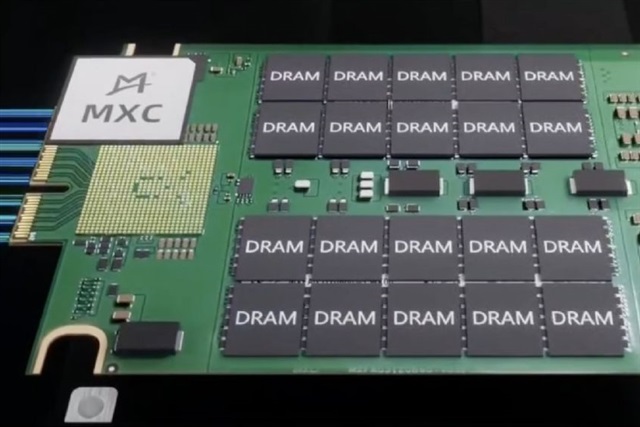
Montage Technology expects its Q3 2026 profit to more than double on DDR5 strength, while Shenzhen's Techwinsemi develops CXL memory-expansion controllers—part of China's broader move into AI-server interconnects.
The strategic story here is not DDR5 volume. It is where the AI datacenter bottleneck has migrated. As inference and agentic workloads scale, the binding constraint is shifting from raw GPU compute toward memory capacity, bandwidth, and the plumbing that connects them. Compute Express Link (CXL) sits precisely at that chokepoint, allowing memory to be pooled and expanded beyond what a single socket can hold. Whoever supplies the register clock drivers, retimers, and CXL controllers earns a quiet but durable toll on every server built. China's designers are climbing exactly this ladder, moving from commoditized module components into higher-margin interconnect silicon that was long dominated by a handful of US-aligned vendors.
For global executives, two implications matter. First, this is import substitution with a purpose: under tightening export controls, interconnect IP is one of the few AI-adjacent layers China can still fully localize, since it rides on mature process nodes rather than leading-edge logic. Second, it introduces a credible second source into a concentrated market, which over time pressures pricing and lengthens the competitive runway for memory-centric architectures. Investors tracking the AI buildout should watch interconnect attach rates as closely as GPU shipments.
For the Japanese market, the signal is concrete. Japan is overweight in exactly the layers this trend amplifies—Kioxia in NAND, Advantest in test, and a deep bench of materials and equipment suppliers whose demand rises as memory content per server climbs. A Chinese interconnect ecosystem that expands total memory addressability is, perversely, demand-accretive for those upstream Japanese players even amid geopolitical friction.
For SIers and enterprise IT teams, the practical takeaway is architectural. CXL-era servers change the total cost of ownership math for on-premise and hybrid AI inference: memory tiering lets teams scale context windows and agent workloads without buying another full GPU node. Japanese SIers designing AI infrastructure for risk-averse enterprises should begin modeling CXL-based memory expansion into reference architectures now, and should treat interconnect supply as a diversification question—not assume a single-vendor world persists.




