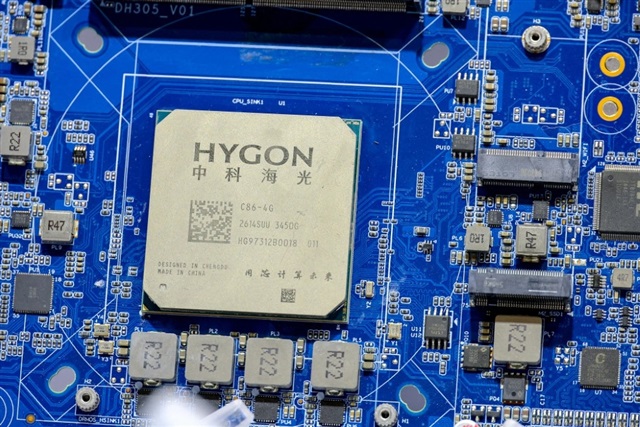
Hygon's roughly 58% nine-month revenue gain is the clearest financial proof yet that China's push to localize high-performance and AI compute is generating real volume. But the simultaneous share-price collapse is the more instructive signal. It tells you the market has already priced in sanctions-driven demand and is now asking harder questions: Where are the margins? How much of this growth is subsidy and mandate rather than genuine performance parity with Nvidia? And can R&D spending compound fast enough to close an architectural gap that widens every time Nvidia ships a new generation?
This is the central tension in the entire Nvidia-alternatives thesis right now. Capital is flowing toward challengers because the strategic logic is obvious: no buyer wants a single-vendor dependency on the most supply-constrained component in technology. Yet the Hygon correction shows that revenue growth alone no longer earns a premium. Investors are separating two very different stories: companies that win on protected demand, and companies that win on merit. Domestic champions insulated by policy can post spectacular top-line numbers while the equity market quietly concludes their moat is a border, not a technology.
For Japan, this is a procurement and sovereignty problem disguised as a foreign earnings report. Japanese enterprises and the SIers that serve them are building AI infrastructure into an ecosystem where hardware choice is becoming a geopolitical decision, not just a performance one. Chinese accelerators are effectively off the table for most regulated Japanese buyers, which concentrates risk back onto Nvidia and a short list of Western alternatives. That makes supply certainty, not peak FLOPS, the real constraint on enterprise AI rollouts here.
The actionable move for Japanese SIers is to stop designing AI platforms around a single accelerator and start building genuine hardware-abstraction layers: workloads that can migrate across Nvidia, AMD, and emerging silicon without a full rebuild. The firms that treat compute as a portfolio to be hedged, rather than a vendor to be married to, will protect their clients from both price shocks and allocation squeezes. Hygon's numbers are a China story on the surface, but the lesson travels: in AI infrastructure, resilience is now worth more than raw throughput, and the market will punish anyone who confuses momentum with a durable edge.




