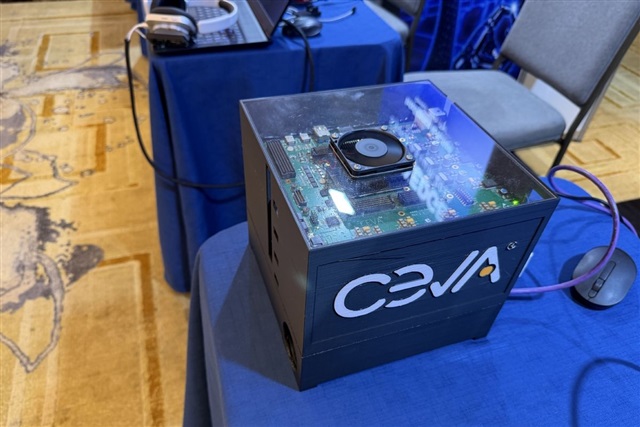
Ceva's move to license its NeuPro NPU cores for AI infrastructure, not just edge devices, is less a challenge to Nvidia than a wager on where margin pressure will land next. The most interesting part is the framing: Ceva explicitly declines to compete with Nvidia and instead sells a common architecture spanning edge and cloud. That is a licensing-business tell. As hyperscalers and systems vendors build their own inference accelerators to escape GPU pricing, the value shifts toward reusable IP blocks that let a customer design once and deploy from sensor to server. Ceva is positioning to sell picks and shovels to the companies trying to route around Nvidia, not to mine the gold itself.
The competitive reality is that Ceva is entering a crowded IP layer. Arm, Synopsys ARC, Cadence Tensilica, and in-house teams at the large cloud providers already contest NPU and DSP licensing. A credible edge-to-cloud story matters because software portability, one toolchain and model format across power envelopes, is often what decides these deals, more than raw TOPS. If Ceva can make a model developed for a battery-powered device scale cleanly into a rack, that reduces porting cost, which is the expense customers actually feel. The risk is that data-center buyers demand proven throughput and ecosystem maturity that an edge-first vendor has yet to show at scale.
For Japan, the relevant angle is custom silicon ambition meeting a shortage of in-house NPU design capacity. Renesas, Socionext, and automotive-tied designers already lean on external IP, and a unified edge-to-cloud NPU fits Japanese strengths in embedded and factory-floor AI better than it fits a pure cloud play. Edge inference is where Japanese manufacturers, robotics, and in-vehicle systems create differentiated value, and licensable cores lower the barrier to building dedicated chips without a full accelerator team.
For SIers and enterprise development teams, the practical signal is that inference is fragmenting across tiers, and architecture choices made now will lock in toolchains for years. SIers advising on on-prem or edge AI should treat IP-level portability as a procurement criterion, not an afterthought, because it determines whether an RPA or inspection workload can later move between a plant-floor box and a central cluster. The teams that standardize on a model format and deployment pipeline that survives hardware changes will avoid the costly rewrites that come when a single-vendor accelerator bet goes stale.




