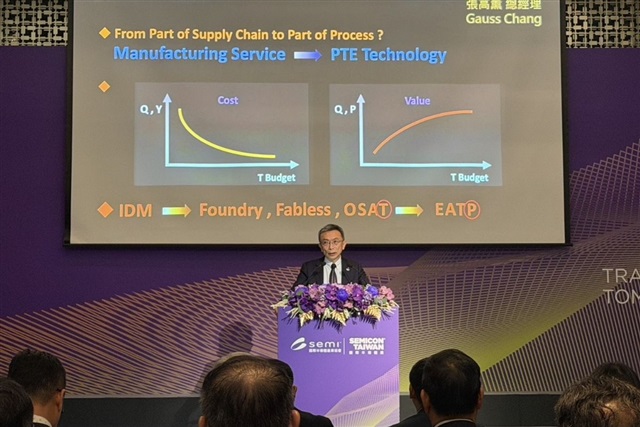
KYEC president Gauss Chang frames semiconductor testing not as a downstream link in the supply chain but as an integral "part of the process," organized around four tightly coupled elements: equipment, accessories, testing, and products.
The deeper signal is economic. For decades, back-end testing was treated as a commoditized, cost-minimized step bolted onto fabrication. AI accelerators break that logic. When a single package fuses compute dies, HBM stacks, and interposers worth thousands of dollars each, an escaped defect is no longer a rounding error but a catastrophic yield loss. Testing stops being about sorting good from bad after the fact and becomes a data-generation function feeding design, packaging, and reliability engineering. That reframing hands pricing power and strategic weight to OSAT and test players who can co-develop with chip designers rather than merely bid on capacity. Expect testing intensity per wafer to climb, test time to lengthen, and the boundary between design-for-test and manufacturing to blur.
The four-way integration model also implies consolidation of leverage. Whoever controls the interface between test equipment, consumables like probe cards and sockets, and the products themselves captures the margin. This is why the back end is quietly becoming a competitive battleground alongside the fabs everyone watches.
For Japan, this is a structurally favorable shift. Advantest sits at the center of AI-chip test equipment demand, and the move toward testing-as-process deepens its embedment in customer roadmaps rather than exposing it to spot-buying cycles. Just as important is Japan's grip on the "accessories" layer Chang highlights: probe cards, test sockets, and precision materials where Japanese suppliers hold hard-to-displace positions. Rising test intensity converts directly into consumables volume.
Japanese enterprises and SIers should read this as a template for their own value framing. The lesson that a function long dismissed as cost overhead can be repositioned as an intelligence-generating process applies squarely to how domestic IT and engineering services are packaged. Test data, and the analytics wrapped around it, is where differentiation now lives. For local device makers and materials firms, the near-term play is co-development partnerships with AI-chip designers and OSATs, locking in qualified positions before the four-way model hardens around a fixed set of incumbents.




